
Most corporate brands enter a room the same way: a banner beside the check-in table, a slide on the screen, a logo on the printed program. A projected mark is a fourth option, and it behaves nothing like the other three. It is made of light, it lands on a surface rather than hanging on one, and it can be colored, resized, softened or switched off between the salad course and the speeches. For a company milestone or a client dinner, that difference is usually the reason to consider it — and also the reason a plan can go wrong.
If you are planning an awards night or a conference reception, the decisions worth making arrive in a fixed order: what the pattern projects, what artwork survives being projected, where it lands, how it ties to the rest of the room’s lighting, and when it should be on. Working in that order is most of the job.
What Custom Gobo Lighting Actually Projects
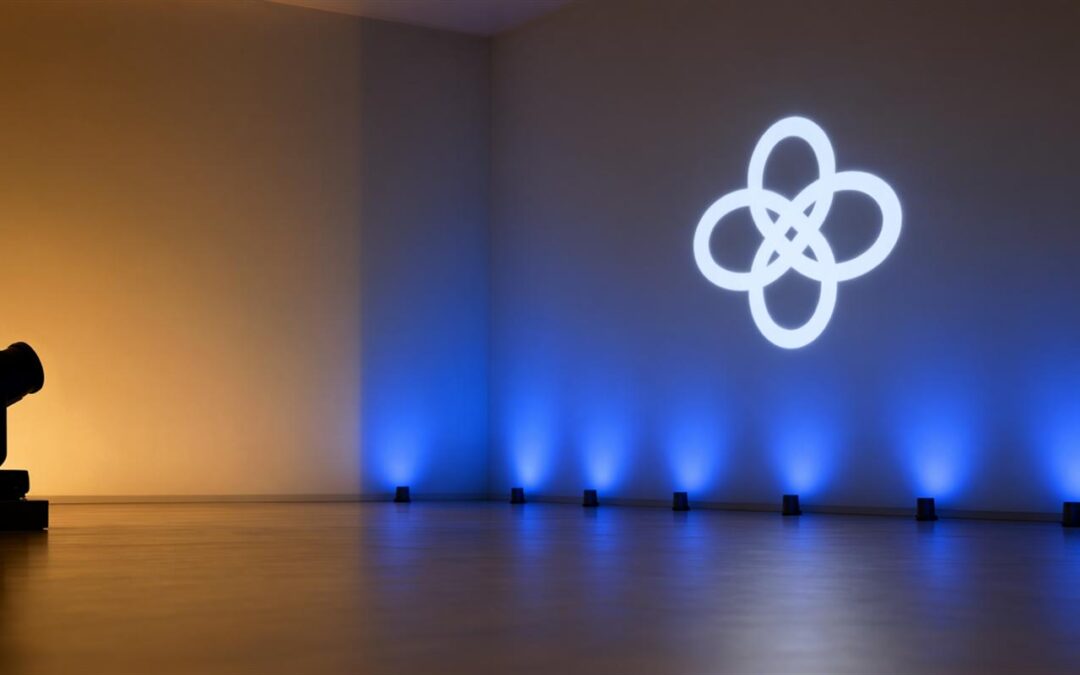
A GOBO is a custom-cut pattern placed in front of a light so that the pattern itself is projected; it can carry a name, a date, a logo or a monogram. The effect is a stencil at room scale, except the stencil is a shadow and the ink is whatever color the fixture is set to.
Because the image is light, it stays adjustable in ways print never does. Moving the fixture changes the size. The same pattern can run in a brand blue for the reception and in white for the award presentation. It can be focused so the edge of the mark stays crisp, or left soft so it reads as atmosphere rather than as signage. What it cannot do is reproduce a logo the way a designer drew it: a photograph, a gradient, or several brand colors at once will not survive the trip through a stencil.
Custom gobo lighting turns a company mark into part of the room, because the pattern is what the light passes through before it lands on a surface. The versions that hold up are usually built from the mark’s silhouette — the shape a viewer recognizes before reading a word.
Why a Logo in Light Reads Differently Than a Logo in Print
A sign gets read. A projection gets inhabited. Guests walk through it on the way to the bar, stand under it for a photograph, and watch it shift color when the room does. That is a different kind of brand presence from a banner, and it costs the room no floor space.
It also reaches places a printed piece cannot go: the ceiling above a dance floor, the wall behind the check-in table, the floor at the entrance to the awards. The corporate event DJ and production services that Tech 3 Productions provides for those evenings build customized branding into the production rather than adding it as a separate order, with monograms, branded photo booth experiences and lighting in corporate colors decided alongside the sound and the schedule.
That framing helps a planning committee, because a projected logo is not another printed item to approve, ship and store. It is a decision about where the brand lives in the room for the length of the evening.
Preparing Logo Artwork That Survives Projection
Projection strips away everything a print logo leans on: gradients, several colors at once, photographic detail, hairline type and small print. A one-color silhouette with solid shapes and open counters holds up; a detailed crest does not. Long wording loses legibility before a compact mark does, which is why a full company name rarely reads as well as two initials.
Most of the work in custom gobo lighting happens before the event, in the artwork rather than in the fixture. The file is prepared once, checked as a proof, and approved by someone with the authority to sign off, which is usually brand or marketing rather than the event lead. Settling those details while the file is open is easier than discovering the problem in the room on the night, when a change is no longer possible:
- a vector version of the mark, rather than a screenshot or an image pulled from the website
- a one-color version, if the brand guide already includes one
- the element that carries the brand — the symbol, the initials, or the full lockup
- the exact wording to be projected, spelled and punctuated as it should appear
- the name of the person who approves the proof before the pattern is cut
Monogram Event Lighting: Where the Projection Lands
Monogram event lighting is the same idea at a smaller scale, where two or three letters carry the brand instead of a full logo. The surface decides whether that works. A plain wall, the ceiling over a dance floor, the floor itself and a backdrop behind a photo area all take a projection, and each one shapes the mark differently.
A wall with heavy texture, a window, an exit sign or a column breaks the image apart. Anything standing in the beam does the same: a plant, a speaker, a table centerpiece, a guest who steps back into it. A floor projection gets walked through all night, which is fine for a compact monogram and less fine for a long word.
Distance matters as well, because the gap between the fixture and the surface sets both the size of the mark and the softness of its edge. That is usually why the choice gets made in the room rather than from a floor plan: the wall the venue actually has, under the light it actually carries, settles what is possible.
Corporate Event Branding Lighting Beyond the Logo
Corporate event branding lighting is planned as a set of layers, so a color wash, a logo projection and the room’s own fixtures read as one system. The projection is a single layer. A wash on the walls carries the brand color across the space, accent light picks out a stage, a bar or a step-and-repeat, and a name can be projected for each award segment instead of being read from a card.
Sponsors and partners need a place in that plan, and the fair way to handle it is to decide early whether their marks get the same treatment as the host’s. A sponsor logo projected smaller, dimmer or off to one side is a conversation waiting to happen.
The guide to how event lighting layers work across a room sets out the base and accent layers in more detail, and the DJ and lighting packages show where a monogram sits in the tier structure: the top tier groups it with uplighting and moving headlights, and photo booth service appears in the Gold and Ultimate tiers.
The branded photo booth option belongs in the same conversation, since the backdrop behind the booth is a projection surface as much as it is a set piece.
Timing the Projection Through the Program
A projection exists only while it is on. That sounds obvious until a plan hangs it like a banner for the whole evening. It belongs to a moment: guest arrival, cocktail hour, the award segment, dinner or the after-party, and each of those moments has different light around it.
The cue belongs in the written run of show, with a named person who calls it and a named person who dims the house lights. A projection competing with a bright screen or a fully lit stage loses, because the eye goes to the brighter surface. A logo on the wall during a keynote is competing with slides that are doing the same job.
Corporate event branding lighting only reads as intentional when the cue is written down, because the projection is not visible while the fixture is off. The corporate holiday party planning checklist is a reasonable place to build that order for a December event, and the same sequence applies to an awards night or a company anniversary.
What to Confirm With the Venue and the Provider
Monogram event lighting depends on a mounting point and a clear surface, so both belong on the confirmation list before the date is locked. The venue sets what can be hung, where it can be hung, what power is available and when the room can be accessed. The provider sets what the fixture needs and who focuses it on the day.
The confirmation list is short: where the light will sit, which surface it will hit, when the room opens for setup on your event day, and who signs off on the artwork. It helps to know that every package already includes a professional DJ and MC, an intelligent LED light show, an HD sound system, two wireless microphones and a back-up DJ and sound system, so the conversation is about where the projection fits into that setup rather than whether the room will have light at all.
Key Takeaways
- The mark’s silhouette decides legibility, so artwork is prepared before the event rather than on site.
- The surface decides whether the projection holds, and texture, windows and obstructions break it.
- Placement follows the sightline and the photograph rather than the floor plan.
- Color ties the projection to the room’s other lighting instead of leaving it as a separate effect.
- The cue belongs in the run of show, because a projection is only visible while it is on.
Conclusion
Tech 3 Productions builds the music, sound and lighting for corporate events around Royal Oak and metro Detroit. The company started in 1997 as a disc jockey service in North Carolina and moved to Detroit in 1999, and the work now runs from awards nights and client appreciation events to fundraisers, holiday parties, weddings and private celebrations. The office is at 416 N. Kenwood Ave, Royal Oak, Michigan 48067, and the number is (248) 259-8237. Check availability and talk through the space before the artwork conversation starts. If your committee is weighing a projection against one more banner, the surface usually decides the design.