

A room reads one way at four in the afternoon and another way at eight. Daylight arrives through windows and goes where it likes; after dark, every bit of light in the room is a decision. That decision sets where guests look, how faces come out in photographs, and which corners of the venue stay quiet. It also decides whether a rented hall still looks like a rented hall. Lighting tends to sit near the bottom of an event budget and near the top of what guests remember, and the useful way to plan it is layer by layer, starting with what the room needs rather than with a photograph of somebody else’s party.
Why Lighting Changes a Room Before Anyone Notices It
Sightlines and color are the two things lighting controls, and both change without a single flower or drape being moved. A wall washed in deep blue reads as a different room from the same wall in warm amber. What guests register is atmosphere. What actually changed is where the light lands, how intense it is, and whether it comes from above, below or the side.
Every Tech 3 Productions package already includes an intelligent LED light show, so the question at booking is rarely whether a room has lighting. It is how far that lighting should reach: a few walls, the dance floor, or the whole room. A space lit on every surface has nowhere for the eye to rest, and a space lit on none has no shape at all.
Start With Questions, Not a Pile of Event Lighting Ideas
A folder of event lighting ideas borrowed from other weddings is a reasonable starting point, but the ideas only work once the room is known. Six fixtures that made a loft feel warm will do very little in a hotel ballroom with a high ceiling and beige carpet. A setup built for a dark country club looks heavy in a room with white walls and tall windows.
Four questions settle most of the plan. What does the room already have — windows, ceiling height, wall color, existing fixtures? What time of day does the event run, and does daylight fade during it? Which moments have to read clearly on camera? And which parts of the room should stay dark on purpose? Answer those and the shopping list usually gets shorter rather than longer.
Uplighting: The Base Layer Most Rooms Need
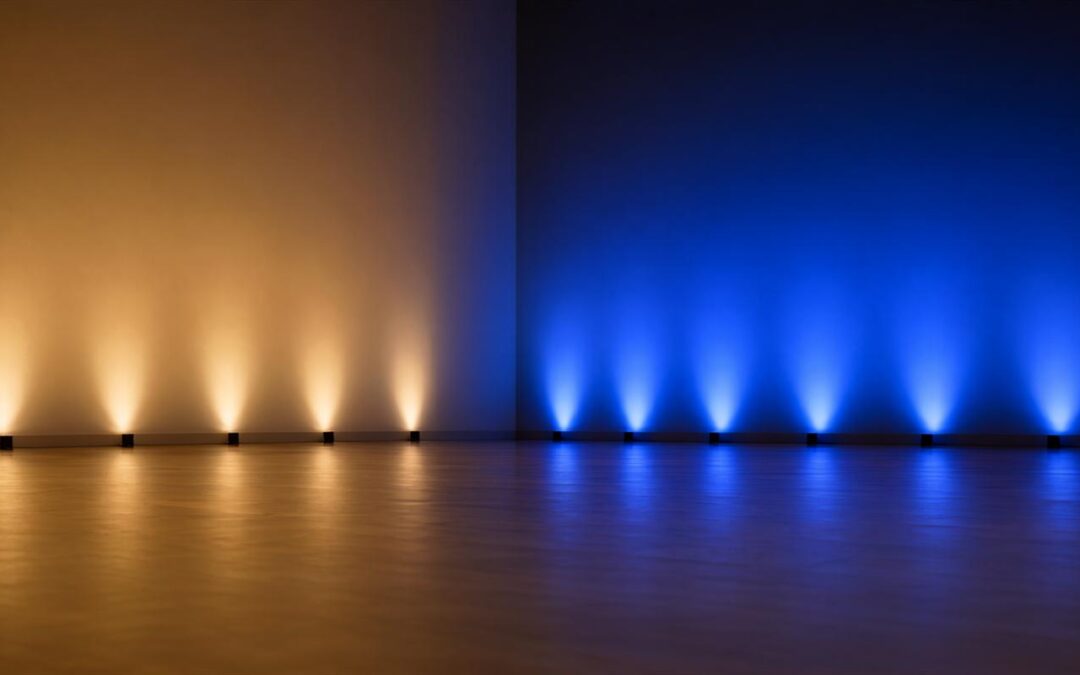
Uplighting places fixtures at the base of the walls and points them upward, so the wall becomes the light source. Colored light washes up the surface and bounces back into the room as a soft glow, which is why a room with uplighting photographs as though it were lit from within. A search for “uplighting event lighting” usually arrives with a color question attached, and the answer depends on the room rather than on a swatch.
Pale walls throw color back brightly. Dark wood, brick and heavy drapery absorb it, so the same fixture setting reads stronger in one room than in the next. Coverage is the second decision: a few walls, the full perimeter, or the entire room. Each step up means more fixtures, more cable to hide and more setup time before the doors open.
Color also has to be chosen against the light the room already has — chandeliers, sconces, exit signs, a wall of windows — rather than in isolation, because an amber that looks warm in one venue turns orange in another. How uplighting sits beside the rest of the lighting options is set out on the packages page.
Wedding Reception Lighting: A Room That Changes Through the Night
Wedding reception lighting is not one look. It is a sequence. Ceremony and cocktail hour want even, flattering light with faces readable from across the room. Dinner wants enough light to read a menu and see the person across the table. A first dance wants a narrower pool — the couple lit, the edges of the room falling away. Open dancing wants the opposite of dinner: a darker room, color in motion, and light that shifts with the song.
That sequence is worth writing down with times attached, because it belongs to the same document as the reception timeline. A note that says “uplighting in amber” leaves the cue to guesswork. A note that says amber for cocktails, blush for the first dance, blue wash once dancing opens can be run exactly.
The Classic wedding experience covers DJ and MC service for up to six hours with HD sound, intelligent LED lighting and wireless microphones. Signature adds uplit accent lighting for the venue and a more immersive reception atmosphere. Ultimate adds up to three hours of photo booth service on top of Signature rather than more light. What each tier carries is compared on the wedding entertainment packages.
Corporate Event Lighting: Brand, Stage, and Sightlines
Corporate event lighting carries a job that wedding lighting does not: it has to serve a program. A speaker, an awards block, a slide deck or a product reveal all need the room to behave in a particular way, and the room usually has a screen competing for the same wall.
Two conflicts show up almost every time. Screens and washes fight, because light aimed at the wall behind a projector screen turns the image to mud, so the plan has to know where that screen goes before any fixture is placed. Brand color is the other. A company blue on a monitor is not the same blue in a wash on a beige wall, which is why corporate event lighting is usually chosen against the brand palette inside the actual room instead of from a chart. Monograms and uplighting in company colors are the two ways to put a brand onto a room, and a branded photo booth adds a third.
The evening rarely ends as a presentation, though, and the lighting has to survive the turn from program to party. Holiday parties, employee appreciation nights, awards dinners, fundraisers and galas, company milestones, client appreciation events and conferences all want different room tones, and each one has a moment when the room should get darker. The scheduling side of a holiday party is covered in the corporate holiday party planning checklist. The service list itself sits on the corporate event page.
Monograms, GOBOs, and Projection: When a Logo Belongs in the Room
A monogram or GOBO is a custom cut pattern projected in light. It carries a name, a date, a logo or a monogram, and it can land on a wall, a ceiling above a dance floor, or the floor itself. The surface decides whether it works. A plain, clear wall takes a projection well; a wall with a window, an exit sign or heavy texture breaks it apart.
The question hosts forget is what sits in the beam. A projection stays clean only if nothing crosses it — a speaker, a plant, a column, or a guest who stands up at the wrong moment. On a dance floor the pattern gets walked through all night, which is fine if the design holds up at an angle and less fine if the word is long. A monogram, uplighting and moving headlights are grouped together as the ultimate lighting set in the higher package tier.
Moving Lights, Fog, and Spark Effects: The Accent Layer
The extras are accents, and they earn a place by being tied to a moment. Moving headlights sweep the room and give open dancing a sense of motion. Low-lying dry ice fog across the dance floor makes a first dance look like it is happening on a cloud. A cold spark fountain marks an entrance or a send-off with sparks that are cold to the touch.
Each one comes with questions that belong in the booking conversation. Where does it sit in the schedule, and who cues it? What does the venue allow, since some rooms restrict fog and some ceilings or fire systems rule out sparks near a stage? What happens to the floor afterwards, given that fog leaves moisture behind? For a birthday party or a family reunion, one well-timed accent usually lands harder than three.
What to Ask Before You Book Any of It
Before a deposit goes down, five questions separate a plan from a wish list.
- Which surfaces the light will hit, and how each one takes color
- How the look changes between dinner and dancing, and who cues the change
- Whether the plan accounts for chandeliers, sconces and window light
- What the venue permits for fog, sparks and anything mounted overhead
- Who sets up, who strikes, and when the room has to be clear
Key Takeaways
- Lighting is chosen per room and per moment, not from a photograph of another party.
- The base layer — a wall wash — does most of the work in a reception or a company event.
- Corporate plans have two hard constraints: readable faces and lighting that leaves the screen alone.
- Fog, moving lights and sparks are accents, and an accent needs a cue in the schedule.
Conclusion
The order that works is simple: read the room, name the moments, choose the base layer, then decide whether an accent has earned its place. Most venues need the wall wash far more than they need the extras, and most schedules need the changes written down rather than remembered. Tech 3 Productions has worked weddings, corporate events and private parties around Royal Oak since the 1990s, after starting as a disc jockey service in North Carolina in 1997. The next step is a date: check availability through the site or call (248) 259-8237. Rooms from past events are collected in the event photo gallery.