
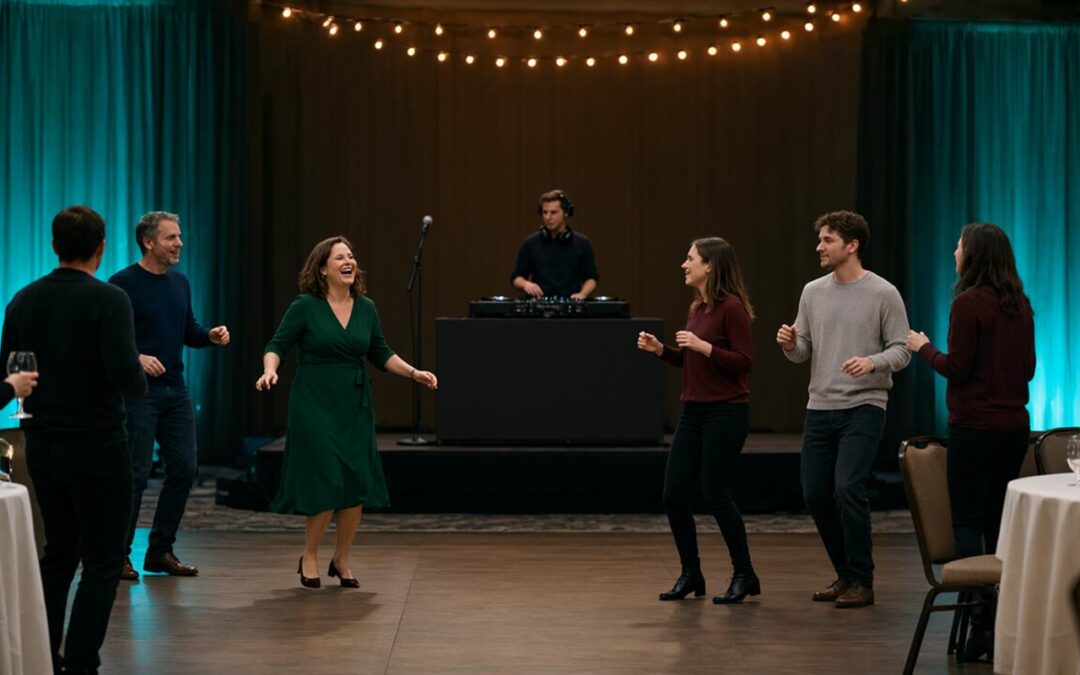
A corporate holiday party asks a company to do something it rarely does: put everyone in one room with no agenda except celebrating. The guest list is the hard part. Colleagues who pass each other in a hallway all year spend one evening as an audience, and the entertainment is what decides whether they settle into their seats or end up in the same photograph. This guide covers the formats worth considering, where entertainment earns its place across the evening, and a planning sequence that keeps the whole thing in order.
What Makes a Company Holiday Party Different From Other Events
A company event brings together guests who did not choose each other. Different shifts, different departments, spouses meeting the team for the first time, and a handful of people who would rather not drink all sit at the same tables. A DJ who plays weddings all summer notices the difference quickly: this room is polite for the first hour, and it loosens once the entertainment gives it a reason to.
The other difference is decision-making. A company party usually has one shared date, a budget approved by someone outside the planning group, and very little room to solve problems on the night itself. Group size swings widely, too. Corporate events and fundraisers sit alongside weddings, birthdays, graduations and family reunions in the same calendar, and those events run from a dozen guests to more than 500 people, so a plan built for the middle of that range usually holds at both edges.
Timing adds a constraint that private parties do not have. A company party normally starts after the workday ends, so the room fills late and unevenly, and the first hour is often played to a half-full floor while people finish up at the office. Placing the biggest moments in the middle of the evening rather than at the start is the usual correction.
Company Holiday Party Ideas That Fit the Room
Company holiday party ideas only work when they match the space. A ballroom with a stage wants something different from a brewery back room, and the format decides how much of the evening the entertainment has to carry. Four shapes come up most often:
- A seated dinner with awards. Formal and structured, dependent on a host who can move the room between courses and recognition.
- A cocktail reception. Standing room and passed food, with music low enough for conversation until the last hour.
- An open house with stations. Guests arrive and leave in waves, so the entertainment has to work for a room that never holds the same people twice.
- A dance-floor party after dinner. Food first, then the tables clear and the evening becomes about music.
Whatever the format, the activity layer fills the gaps between programmed moments. A photo booth for corporate parties gives guests something to do after dinner and produces the thing they actually take home. The Gifyyy iPad booth texts an animated GIF straight to a guest’s phone, while the Photo Printz booth arrives with an attendant, props and unlimited prints.
Where Corporate Holiday Party Entertainment Fits in the Evening
Corporate holiday party entertainment does more than fill silence, and the job changes hour by hour. Arrival and cocktails want background music at a volume that lets people introduce themselves. Dinner wants the same, with a lift at each transition. The speech and awards block is where the entertainment is least visible and most useful: someone has to hand over a wireless microphone, keep the level steady, watch the clock, and pull the room back once the last award is handed out. After that, the music is the event.
The practical version of that is a host who reads the room rather than a playlist that runs on a timer. A corporate event DJ service covers both halves of the work, the microphone moments and the music, which is the part worth confirming when you compare options. Every package from Tech 3 Productions carries an experienced MC and DJ with club-level mixing, an intelligent LED light show and a professional HD sound system, two wireless microphones for speeches and toasts, and a back-up DJ and sound system.
A Holiday Party Planning Timeline That Holds Up
Holiday party planning falls into an order, and it is not the one most checklists follow. Start with the date and the room, because both are fixed constraints that everything else answers to. Then settle the headcount and the menu, since those decide whether the evening is seated or standing and how much of the night belongs to a dance floor. Entertainment and its additions come next: lighting, a photo booth, the extra hour that turns a dinner into a party.
Once the date is fixed, check availability for a date with the provider instead of waiting for the rest of the plan to settle, because the date is the one item that cannot be reworked later. That conversation usually covers the room’s layout, the setup window, and who is coordinating on the venue side.
The run sheet comes last and matters most. It lists arrival, dinner service, the speech block, the first dance-floor song and the end of the night, and it is the document a host, a venue manager and a DJ all work from. Build it in the final weeks and read the last week as confirmation rather than construction.
Questions Worth Asking an Entertainment Provider
Who runs the microphone? A DJ who also MCs will announce toasts and keep the schedule; a DJ who only plays music leaves that work to someone from the company. Ask directly, because the answer decides who is responsible for the room.
What sits in the package and what is added? The Bronze, Silver, Gold and Ultimate packages stack in a clear order: Bronze covers DJ service and the LED light show, Silver adds up-lighting with up to 20 lights in any color, Gold adds up to three hours of photo booth service with props, unlimited sessions, digital files, an attendant and a photobook, and Ultimate adds moving headlights, a custom monogram, Dancing on a Cloud and cold sparklers.
What happens if something fails? Ask what to expect from an event DJ on event day, including the setup window, the floor space the equipment needs, and the plan if a speaker or a laptop dies mid-speech. A second microphone and a second sound system are the answer to look for.
Who handles requests? Guests will ask for songs. Deciding in advance whether requests go to the DJ, to a company host, or nowhere at all keeps the dance floor from turning into a negotiation.
Music, Speeches, and the Moments People Remember
The speech block is where a corporate party most often loses its shape. Four speakers become six, one of them opens a laptop that will not connect, and the room drifts toward the bar. The fix is administrative rather than musical: a named order, an agreed length per speaker, one person holding the microphone, and a host willing to move things along.
Music needs the same kind of decision. A short do-not-play note is worth writing, and so is a line about guest requests, whether they are welcome, filtered or collected on cards. Writing those preferences down is the same task couples take on when they prepare a music request list; the corporate version is shorter because the audience is narrower. Volume is the other variable, since music that suits conversation over dinner rarely suits the same room an hour later. The run sheet carries that shape, much as a written reception timeline gives a wedding DJ a sequence to work against instead of a guess.
A Party That Works for the Whole Company
The measure of a company holiday party is whether the people who usually leave early are still in the room at the end. That is a planning outcome, not a music one: a format that suits the space, a photo booth with something to do, a speech block that respects the audience, and a dance floor that opens at a sensible hour. Tech 3 Productions has worked that combination since 1997, when the company started as a disc jockey service in North Carolina, moved back to Detroit in 1999, and added a photo booth in 2012, earning a 2021 WeddingWire Couples’ Choice Award along the way. The company is based in Royal Oak, and its availability calendar shows which dates on the company party schedule are still open.
Key Takeaways
- Match the format to the room before choosing anything else: seated dinner, cocktail reception, open house or dance floor.
- Give the entertainment a job in every hour, from background music at arrival to the microphone block to the last song.
- Fix the date and the venue first, then headcount and menu, then entertainment and its additions.
- Write the run sheet and the do-not-play note, because both replace guesswork on the night.
- Ask who MCs, what the package includes, and what happens if equipment fails.