
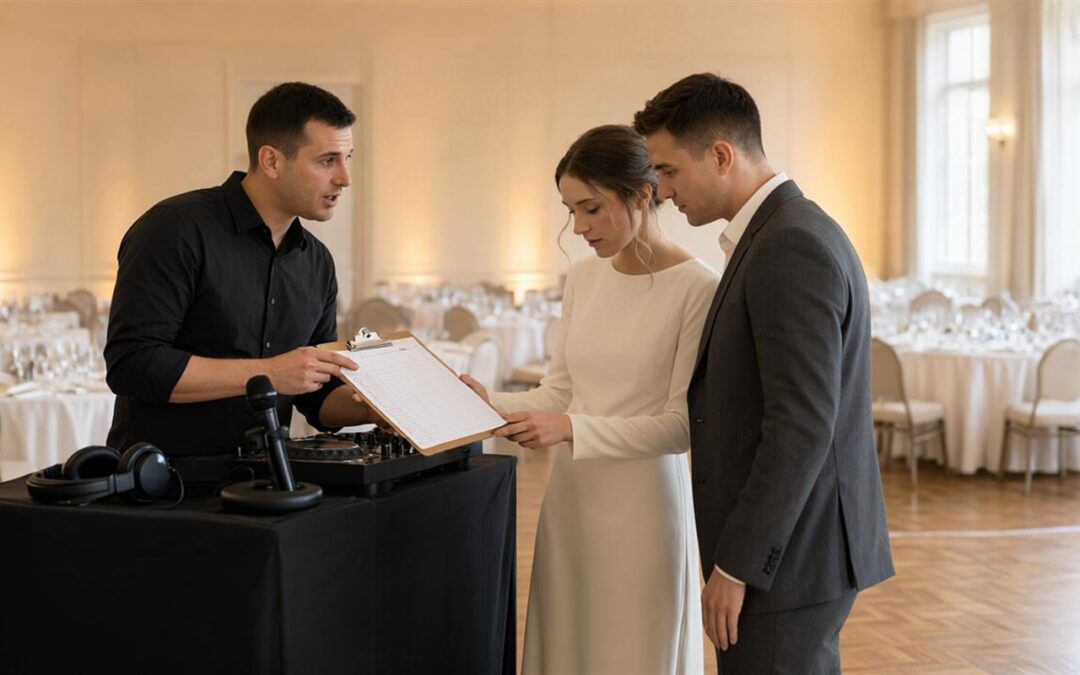
Most of the questions couples bring to a DJ are about music. The question that shapes the evening more than any playlist is quieter: what actually happens, and in what order. A wedding reception timeline is the written answer, and the version a DJ can work from carries more than the running order in your head. It is the difference between a room that moves from dinner to dancing because someone planned it and a room that waits for someone to decide.
Why the Reception Timeline Starts Long Before the Dance Floor
Timelines get built in the last week and used on the day, but the useful ones are assembled much earlier, alongside the venue contract and the photographer’s plan. A reception is a chain of handoffs: catering needs the room, the photographer needs the light, and the DJ needs the microphone moments to land where the other vendors expect them. When those three work from the same order, the evening stops competing with itself.
That is why the DJ’s copy matters more than it looks. Every Tech 3 Productions package includes an experienced MC/DJ with club-level mixing, two wireless microphones for speeches and toasts, and a back-up DJ and sound system. The person holding that microphone is the one introducing the couple, cueing the toasts and telling a room full of guests where to look, so the order they read from has to match the one the caterer is cooking to.
The day itself has its own rhythm — load-in, setup, sound check, the party, load-out — and that sequence rarely changes. What changes is the timing, which is exactly what a written plan pins down. The event-day side of the job is covered in what to expect from a professional event DJ on event day, so this guide stays on the document you hand over before any of that starts.
What a Wedding DJ Run Sheet Actually Holds
A wedding DJ run sheet is a working document, not a script. Two pages is a sensible ceiling, because anything longer tends to go unread on a day when nobody has time. What it needs is the order of the evening, the names that will be said out loud, and the cues that tell the DJ when each block begins and who gives the signal.
Beyond the running order, the sheet carries what a DJ cannot guess: the pronunciation of every name being introduced, the songs that must and must not be played, the venue’s sound limits, and where the add-ons sit in the evening. A couple who has booked the wedding DJ service usually has most of this scattered across emails, contracts and phone notes. The run sheet is where it gets collected into one place.
The pieces worth writing down:
- The order of the reception, block by block, from guest arrival to the last dance.
- The names and pronunciations of everyone being introduced or speaking, and who is announcing them.
- Must-play songs, do-not-play songs, and the processional, first dance and family dance choices.
- Any cue that depends on another vendor, such as dinner service, the cake cutting or a photographer’s exit shot.
- The venue’s rules: sound limits, the end time on the contract, and where equipment can be placed.
- The one person the DJ should find on the day, with a phone number that will actually be answered.
One line at the top of the page saves the most trouble: the version and date. A sheet marked as the third revision, reviewed two weeks out, tells the DJ which copy is current when three of them are sitting in an inbox.
A Sample Order for the Reception, Block by Block
Most receptions follow the same broad shape, even when the details differ. Guests arrive and settle while cocktails and background music fill a room that is still half empty. Then come the seating and the entrances, where the first announcements set the tone for everything after them. Dinner follows, and the music steps back so people can talk. Toasts come next, and this is the block where the microphone matters most: a quiet room, a clear introduction for each speaker, and a return to music that lifts the room again afterwards.
The first dance and the family dances open the floor, often followed by the cake and then open dancing. Late in the evening the last dance closes the floor deliberately, and the send-off gives guests a clear ending rather than a slow drift toward the door. A wedding reception timeline that names each of these blocks gives the DJ a map, and gives the couple a way to see where a photographer’s request or a caterer’s schedule will collide with the music.
What each block really asks of the DJ is a cue: who starts it, what plays underneath it, and how it ends. Write those three things next to each block and the rest of the page can stay short.
The Details That Get Missed on Paper
Names are the first thing to go wrong and the easiest thing to fix. A name spelled one way and said another, a nickname that only family uses, a speaker who prefers a married name — all of it belongs on the sheet, written phonetically if that helps. An introduction only lands when the pronunciation is right, and a mispronounced name is remembered longer than any song.
Then there is the question of who the DJ talks to. A couple on a wedding day is pulled in six directions, so naming one point of contact — a planner, a parent, a member of the wedding party — keeps questions from landing in the middle of a first dance. That person should also hold the venue’s end time and sound limits, which usually sit in a contract signed months earlier and rarely get read twice.
Add-ons need a slot on the page too. Up-lighting and a custom monogram are set before guests arrive, so they belong in the setup notes rather than the running order. Dancing on a Cloud, the low-lying dry ice fog used for a first dance, and cold sparklers, which send up a fountain of sparks that is cool to the touch, are moments with a cue attached, and the DJ needs to know which song carries them. The photo booth options for the reception are worth timing as well, since a booth that sits idle through dinner and then draws a queue once the dancing starts is a scheduling problem rather than a booth problem.
How a Wedding DJ Timeline Handles the Last Two Weeks
Send a working draft early, weeks out rather than days, and a final version about two weeks before the wedding. The early draft gives the DJ time to notice a gap: a first dance with no song chosen, a toast with no speaker listed, a stretch between dinner and dancing that needs filling. The final version is the one that gets used, so it should look like a finished document rather than a thread of corrections.
Changes in the last two weeks are normal, and the way to handle them is to mark them. Edit the document, change the version date, and say what moved in a short note. Five emails carrying one change each is where a timeline falls apart; one document with a change log is where it holds. The final conversation is the place to settle what is left — who gives the signal for each block, what the last song will be, and how the evening ends.
That conversation is also the moment to confirm the package, because the equipment and the running order are connected. The Silver level adds up-lighting of up to 20 lights in any color, the Gold level adds up to three hours of photo booth service, and the Ultimate level adds moving headlights, a custom monogram, Dancing on a Cloud and cold sparklers, each one a cue on the page. Reading through the DJ packages and add-ons beside the draft is the simplest way to check that what is planned is what is booked.
Key Takeaways
- A wedding reception timeline works better as a short written document rather than a playlist and a conversation.
- Include the order of the evening, names and pronunciations, music must-plays and do-not-plays, and the venue’s rules.
- Name one point of contact for the day, with a number that will be answered.
- Send a working draft weeks ahead, then lock the final one roughly two weeks before the date, with every change marked.
- Give each add-on a cue: lighting and monograms before guests arrive, sparklers and fog tied to a song.
A Clear Run Sheet Makes a Calmer Reception
A reception does not need a minute-by-minute script. It needs an order everyone can see, names that are said correctly, and a DJ who knows which moment is next and who starts it. That is what the document buys: fewer decisions made in the middle of the evening, and more of the evening spent where it belongs.
Tech 3 Productions has been playing weddings and events since 1997 and holds a 2021 WeddingWire Couples’ Choice Award. If the date is still open on the calendar, check available dates on the site or call (248) 259-8237. The run sheet can come later; the first step is a conversation about the day.